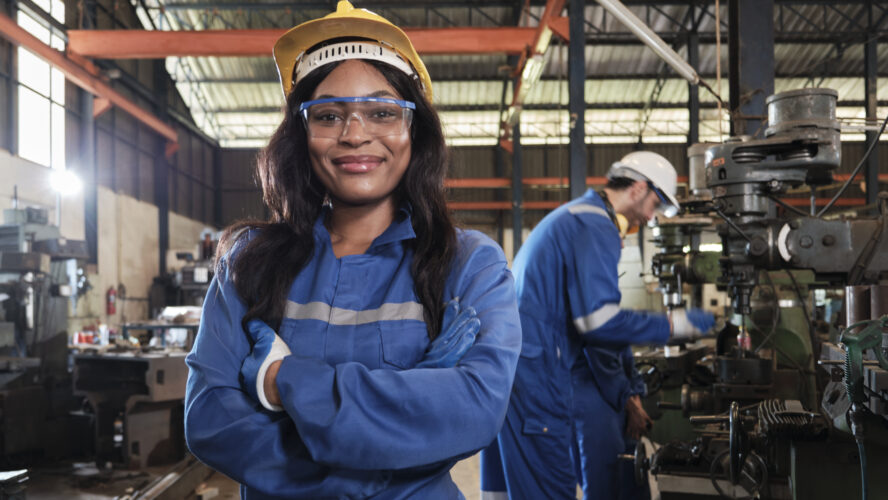

More women are entering the trades, but lasting progress depends on stronger family support, training access, and fair workplace policies.

Virginia Rodino
Executive Director, Coalition of Labor Union Women
Workers in manufacturing and skilled trades jobs have literally helped to build this nation. Through the years, unionizing these workforces has been key to turning those manufacturing jobs into good jobs for millions of working people. How have women been welcomed into this critical workforce, and what is necessary to make the skilled trades more inclusive?
Using calculations based on the U.S. Bureau of Labor Statistics’ data, the Institute for Women’s Policy Research found that the number of women working in the trades reached the highest level ever, with 363,651 working in construction and extraction occupations in 2023. From 2018 to 2023, the number of tradeswomen increased by more than 80,000, a growth of 28.3%. Yet, even with this growth, tradeswomen are only 4.3% of those who work in construction, and just 3.1% of carpenters, 2.9% of electricians, and 2.2% of plumbers, pipefitters, and steamfitters.
Lack of family-oriented benefits and support
According to Jobs for the Future, the construction industry’s lack of pregnancy and family medical leave policies can limit women’s ability to complete apprenticeships successfully and safely, often forcing tradeswomen to choose between their work and their families. Construction trade apprenticeships offer a pathway for parents to earn a family-sustaining wage, yet women remain underrepresented in these roles.
In a 2021 survey of tradeswomen by the Institute for Women’s Policy Research, 63% of parents with children under age 18 who said they had seriously considered leaving the trades mentioned a lack of pregnancy accommodations as a very or somewhat important factor. 56% of tradeswomen younger than 35 who do not have children cited a lack of pregnancy accommodations among their reasons for considering leaving the industry.
Manufacturing employs 1 in 10 workers in the United States, but fewer than a third of workers are women, and women are particularly underrepresented in many higher-earning shop floor positions that typically do not require a four-year college degree. This report draws on responses to the 2022 IWPR Women in Manufacturing Survey, which was specifically designed to capture the experiences of women working on the shop floor.
In a 2022 survey of women workers, over 7 in 10 respondents reported they stay and succeed in the industry because of pride in their work (73.1%) and opportunities for learning new skills (71.7%). Nearly 7 in 10 (68.5%) highlighted the importance of support from their union locals for their success and staying power in manufacturing. Union members pointed to the collective voice they have as members, as well as mentorship and support from other women. Over 6 in 10 respondents (64.2%) identified the role of formal policies to create equitable workplaces, including anti-harassment policies and commitments to equitable hiring and diversity goals. Pre-apprenticeship programs are an important entry point to manufacturing jobs and provide mentorship and support in the longer term. Close to 6 in 10 (58.9%) of respondents who completed such programs attest to their importance for their success.
Supporting workers’ rights
This survey concluded that to attract, retain, and advance women in manufacturing, employers need to have more systematic outreach and recruitment as well as effective anti-harassment policies; diversity, equity, and inclusiveness training; and monitoring and complaint processes. Expansion of and access to training, apprenticeship, and pre-apprenticeship programs are important. To ensure that women and all workers with caregiving responsibilities are able to work in manufacturing, childcare and caregiving support should be expanded, and comprehensive paid leave policies must be instituted that are accessible to all.
Importantly, survey responses revealed that unions are key to ensuring that manufacturing jobs remain good jobs and that unions play a key role in creating the conditions needed for women to thrive in manufacturing. Therefore, as attacks on workers and their unions are being battled, as a nation, we must stand behind our workers, their rights, and their dignity in the workplace. Supporting good jobs means supporting workers’ unions, workers’ rights, and equality and equity for all.
