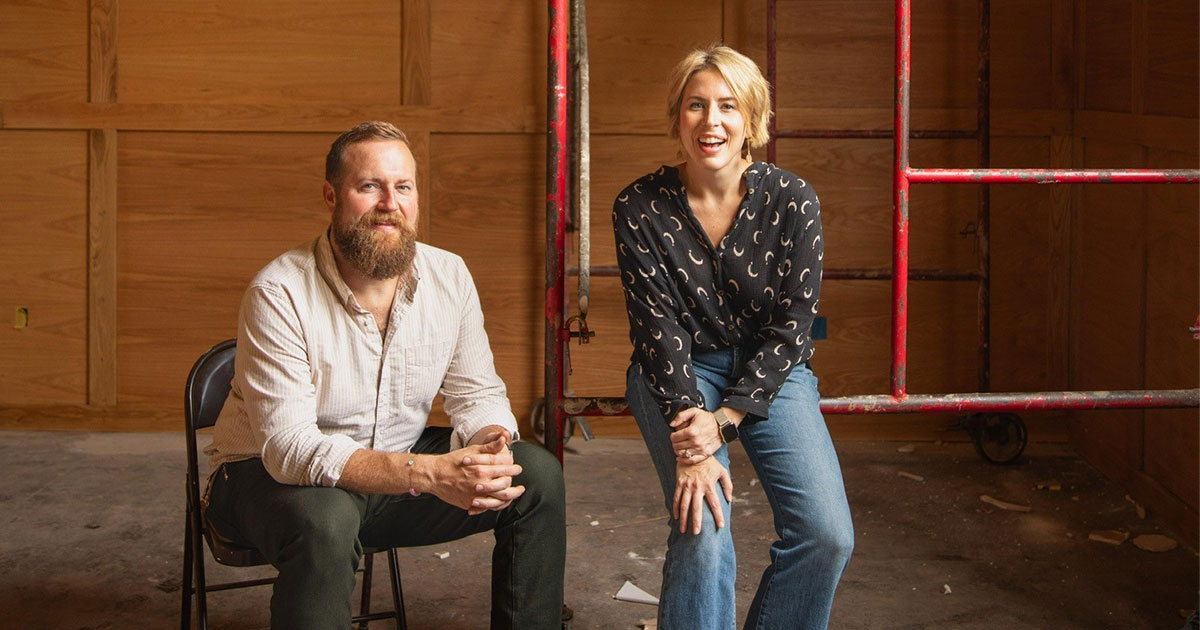
Ben and Erin Napier, hosts of HGTV’s “Home Town,” have built businesses rooted in handmade craftsmanship in small-town Laurel, Miss. They see the revival of skilled trades as both an economic opportunity and a cultural shift.
How do you see modern technology fitting alongside old-school skills rather than replacing them?
Ben Napier: I think a big mistake people make is framing it as an either/or conversation. This is a lesson I learned from John Bassett at Vaughan Bassett Furniture. A CNC machine doesn’t replace a woodworker, but it can free him up to spend more time on things that require human hands and judgment. Some of the very best craftsmen I know use technology as a tool, the same way a carpenter uses a nail gun but still knows how to drive a nail by hand. In my opinion, the skill has to live in the person first before technology can enhance their abilities. We have been modernizing craftsmanship since before the Industrial Revolution.
Erin Napier: I’d add that technology has made it easier to tell the story of handmade goods in a way that wasn’t possible before. A maker in a small town like Laurel can now reach someone in Oregon or even overseas because of social media and e-commerce. So, in that sense, technology has been a gift to the skilled trades as a means of expanding your audience. We are prime examples of that.
What advantages do small towns have that big cities don’t when it comes to producing goods or supporting skilled trades?
EN: Space — and I mean literal, physical space. You can have a workshop, a yard, a warehouse, and not be paying Manhattan rent for it. However, the greatest asset to a small town is community. There’s a supply chain that’s built on relationships and trust, in which the guy who builds furniture probably knows the guy who mills the lumber, who knows the family that’s been farming that land for three generations. All of them have the local machine shop on speed dial for when their equipment breaks.
BN: Small towns also still have this culture of fixing things. Just because we live in the modern next-day delivery era doesn’t mean you can get next-day or afford what next-day costs. We know we can find someone who can repair it, or we figure it out ourselves. That mindset is the soil that skilled trades grow in. I don’t think that is lost in big industrial cities, but it might be harder to find. When your default is to replace rather than repair, you stop valuing the people who know how to make things in the first place.
Erin, you’ve talked about storytelling and design being essential. How can branding, design, and creativity help American-made products compete globally?
EN: When you have a beautiful, well-made product, well-designed marketing materials, and the reach to tell the full story across the globe, then you’ve struck gold — because people don’t just buy a product, they buy what it means. American-made goods resonate around the world because they represent the idea of building with intention rather than for profit. The design is the thing that pulls consumers in, but it’s the story behind it that they can really connect to. To compete globally, you have to make consumers proud to tell people where it came from and that they’re part of something bigger.
Ben, you’ve spoken about beauty disappearing from everyday products. Do you think bringing artistry back into manufacturing could be a business advantage?
BN: I feel like we are tired of buying furniture that looks exactly like everyone else’s. There’s a real hunger for things that have a little soul to them, because when you bring genuine artistry into a product, it stops being a commodity. Watch movies or commercials. Set designs and the cars that characters drive tell the story of that character. We need to be doing this in modern manufacturing. Best Home Furnishings says it is a mass customization manufacturer. I love that. You’re no longer competing on price alone, and that changes everything for a small manufacturer or a large one. You can charge fairly for what something is actually worth when people can see and feel the difference. The other thing is longevity. A well-designed, well-made object lasts; it gets passed down. That’s the opposite of the throwaway economy, and I think people are genuinely ready to return to it.
What excites you most about the future of American manufacturing?
BN: For me, it’s that young people are choosing blue-collar jobs across the board. When I look at these jobs, I see the people I grew up admiring. While admiring those people, I was being told to go to college and get an office job. This next generation is full of kids who are smart enough to look at the traditional four-year college path and decide that’s not the only way. Some of them are picking up tools instead. I am a little jealous of them. The knowledge isn’t going anywhere because there are people willing to carry it forward.
EN: What excites me is the intersection of creativity and manufacturing. We’re seeing designers and craftspeople collaborate in ways that are producing things that are genuinely world-class. People want to know where their things come from now. There’s a real transparency movement happening with consumers. For centuries, customers didn’t care where it came from. Toward the end of the 20th century, we started seeing cheap goods and cheap prices from other parts of the world. Naturally, consumers jumped on those prices. Now, we are seeing the toll that has taken on our small towns, and we are honestly kind of sick of this disposable consumer culture. That’s why the tagline of Laurel Mercantile Co. is “durable goods and heirloom wares.” We would rather save our money and buy a quality product or wait for a hand-me-down from our family. American manufacturers who can say “Here’s who made this, here’s where the materials came from, and here are the hands it passed through” have an incredible advantage. We just have to be brave enough to tell those stories loudly and proudly, because our bottom line is more than just profit.
