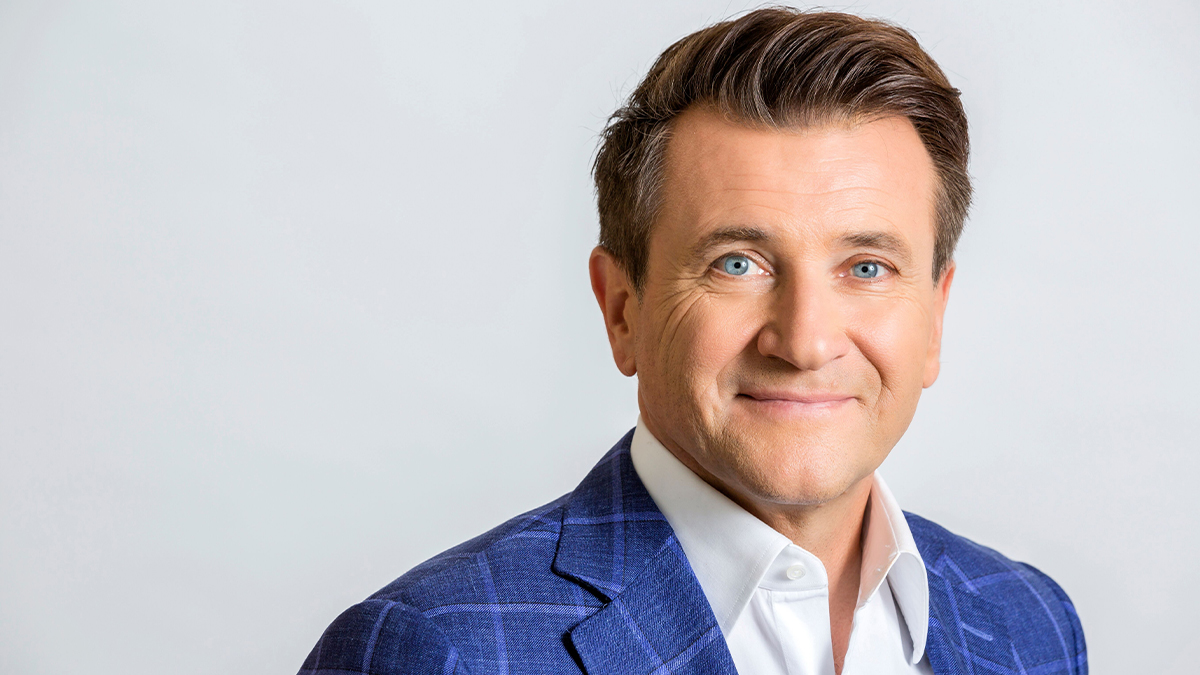
“Shark Tank” investor and entrepreneur Robert Herjavec discusses AI, ambition, and why growth is always a good problem to have.
Small Business Month is a chance to spotlight the people building under real pressure. When you look at the small business landscape today, what do you think is the biggest challenge owners are being forced to navigate?
There is an excitement in the air about starting a business. I was recently reading that new small business applications are up by 39%. That’s great. I think there are a couple of factors driving this: “Shark Tank” is one. We have democratized the starting of a business. We have shown people the questions to ask, and if the six of us can do it, literally anyone can.
Second: AI. This is the most powerful technology in our lifetime. You can be a programmer without knowing how to program; you can build scale and efficiency without a large staff. People are starting to realize how powerful AI is, even in traditional businesses. Of course, people are also waking up to the fact that AI is probably the greatest threat to white-collar jobs in our lifetime.
Many entrepreneurs are great at their product or service but struggle to scale the business itself. In your experience, what separates a strong operator from someone who is simply overwhelmed by growth?
First of all, being overwhelmed by growth is a good problem to have. In business, there are lots of bad problems — low margin, lack of cash flow, not enough customers. Growth is a good problem, but it can still be a problem. The trick is being one step ahead of growth. Business is so dynamic today that having multi-year plans is nearly impossible. There is too much change. Great entrepreneurs put in the resources their business needs just before it needs them. The other key trait is understanding that you need a team. A good entrepreneur is the best salesperson, accountant, and product manager in their business. Great entrepreneurs build great leaders; they aren’t solopreneurs.
Small businesses often face tight cash flow and limited room for error. How should owners think about balancing ambition with smart risk-taking?
Every time you see a small business, someone made a courageous decision. There is no lack of ambition in a business — no one starts a business to fail — but ambition needs to be balanced with risk. Mistakes and risk are part of the currency of running a business, but I always like to say, taking risks is good, but try not to take a risk that could cost you the business. Running out of cash is very hard to come back from.
Hiring and retention continue to be major concerns for smaller companies. What have you learned about building teams that can grow with the business rather than hold it back?
The minute you hire your first employee, you are starting to build scale, and the growth of your business from then on will be based on your hiring and retention capability. Creating a culture that attracts great people and gets them to stay is paramount. People want to be led, not managed, and great people want to do great work. I think it is important to have a big vision for people to rally behind. Also, never underestimate the power of fun. Coming to work should be exciting and not a chore. Finally, winning is the best culture catalyst. It’s hard to get excited about a business that is losing and not growing.
Cybersecurity and digital risk have become real concerns even for smaller businesses. What mistakes do you think small business owners still make when they assume they are “too small” to be vulnerable?
Cybersecurity is highly complex, yet incredibly simple in so many ways. Most small businesses miss the basics. 85% of all malware still comes through email. Do the basics: update passwords, protect the endpoint with great software like CrowdStrike, set firewall rules, and use multi-factor authentication. Just doing this will eliminate 90% of potential threats. Beyond this, find a great technology partner to help you with cyber.
For entrepreneurs trying to grow in uncertain conditions, what metrics or signals matter most when evaluating whether the business is actually healthy?
Every business has a heartbeat; it’s up to you as the owner to know what that is, and no two businesses are the same. In my business, new client acquisition and cash flow were the key metrics. You could wake me up in the middle of the night, and I could tell you what those numbers were every day. What is the heartbeat of your business? There are lots of important numbers, but there are usually one or two metrics that are critical.

What do you think small business owners get wrong about sales and customer acquisition, especially when they are trying to scale beyond founder-led hustle?
Most small businesses don’t fail because of a lack of cash; that is a myth. They fail because of a lack of sales. Without sales, you don’t have a business. One of the biggest mistakes I made as a founder was taking too much pride in always being our best salesperson, until I realized that if I am always our best salesperson, we are never going to be able to grow outside of me. As we scaled from two people to over 1,000, I continued to be involved in sales, but I was far from our best salesperson. Most founders make the mistake of treating sales as something requiring luck or simply a great personality. Sales can be measured — inbound calls, conversion rate, pipeline. Treat sales like a science, and you will always make a certain target number.
On “Shark Tank,” you see a wide range of entrepreneurs. What qualities still stand out most to you when you see a founder who truly has the potential to build something durable?
On “Shark Tank,” we see it all, but we have learned over the last 17 years that great entrepreneurs have great vision and obsession with their business, balanced with great realism. A great entrepreneur has to believe they can make the world into what they see it to be, not what it is, but they are also realistic enough to make a quick pivot and adjust when things change. Adaptability is the key to survival.
What advice would you give to small business owners who feel stuck between wanting to grow and fearing the operational complexity that comes with growth?
If you fear growth, you are not running a business; you are doing a hobby, and there is nothing wrong with that. Lots of people start a business because they love to bake and they have a romantic vision of owning a bakery. If you have the capital and that makes you happy, go for it. But business is a full-contact sport. They say there are only three types of businesses: those that are growing, those that are not growing and are dying, and those that don’t realize they are dying.
During Small Business Month, what do you want more people to understand about the resilience, sacrifice, and economic importance of America’s small business community?
Anyone can start a business. There is no virtue or talent you need to be born with. I have a classical English degree and built a massive cybersecurity business around the world. The trick is to be realistic with your ambition. Everyone wants to be successful, but few people are willing to pay the price.
Starting and running a business is all-encompassing: At the beginning, there is no balance, there are no days off, there are no vacations. Look very hard at yourself and ask whether that is the price you are willing to pay. There is nothing more satisfying than building something great for yourself, your family, and your team, but it is a lot of sweat equity.
